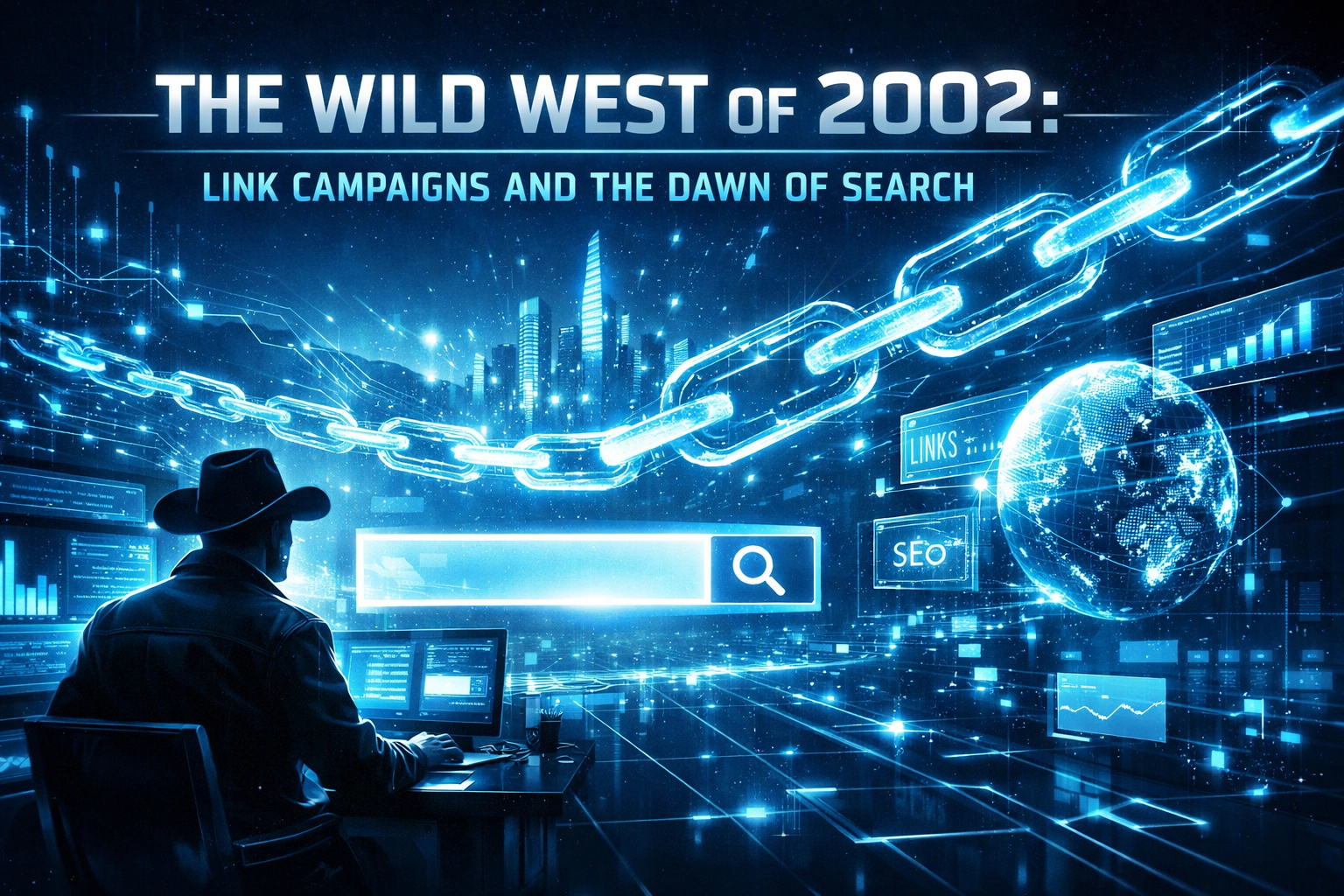
If you close your eyes and listen closely, you can almost hear the screech of a 56k dial-up modem struggling to stay connected. It’s 2002. The world was a different place. Most small business owners were still debating whether this "internet thing" was a passing fad or something they actually needed to care about. I didn’t have that doubt. I was already deep in the trenches, looking at search engine results pages (SERPs) and realizing that we were standing on the edge of a digital gold rush.
This is the start of a series where I’m going to take you through my 30-year journey in the world of digital marketing. It hasn't always been pretty. There were massive wins, spectacular failures, and a whole lot of "figuring it out as we went." But those early days: the true Wild West era: are where the foundation for Absolute Velocity Labs was actually built.
The Landscape: When Yahoo! Was a Directory and Google Was the New Kid
In 2002, the search landscape was fragmented and chaotic. People were still using AltaVista, Lycos, and Ask Jeeves. Yahoo! was still predominantly a human-edited directory, which seems like a prehistoric concept today. If you wanted to be found, you submitted your site and hoped a human being liked it enough to categorize it.
But then there was Google.
Google was the disruptor. By 2002, they had just secured a deal to power AOL Search, which effectively gave them over 50% of the search market share. They brought something called PageRank to the table, and suddenly, the "rules" of the game changed. It wasn't just about keywords anymore; it was about authority. And authority, in the eyes of the early Google algorithm, was measured by one thing: links.
Back then, there were no local seo services in the way we think of them now. There were no "best practices" or "white hat vs. black hat" debates that had any real teeth. It was pure, unadulterated experimentation.

The Dawn of Link Campaigns: Pure Grit and Manual Implementation
My role during this time was intense. I was integral to the planning and implementation of massive link campaigns. We didn't have automated tools. We didn't have AI to crawl the web for us. We had spreadsheets, coffee, and sheer determination.
At the time, the algorithm was incredibly primitive. There was no "niche relevancy." If you were trying to rank a site for a florist, a link from a high-ranking automotive forum was just as good as a link from a gardening blog. It was a numbers game. I spent my days (and many nights) architecting these link networks, identifying which sites held the most PageRank, and figuring out how to get our clients' URLs onto those pages.
I want to be clear about one thing: while I was the architect and the one leading the charge on the implementation, I wasn't doing it alone. I’ve been lucky enough to lead and be part of some of the most talented teams in the industry. Those early wins were collaborative efforts. We were a group of people who realized we could influence the most powerful information-gathering tool in human history, and that realization was intoxicating. We were providing digital marketing solutions before the term was even popularized.
The Wild West Mentality: Playing Without a Ref
There is a certain thrill in playing a game where the referee hasn't been hired yet. In 2002, Google was the referee, but they were still learning the rules themselves. This was the era of the "Google Bomb." You could coordinate a group of people to link a specific phrase to a specific page, and Google would treat it as absolute truth.
We were testing the limits of what was possible. We weren't just building links; we were reverse-engineering an algorithm in real-time. If we noticed a spike in rankings after a certain type of link implementation, we doubled down. If a site dropped, we pivoted. This "old-school grit" is something that has stayed with me for three decades. It’s the ability to look at a problem, realize there is no manual, and build the solution from scratch.
This experimental nature is what eventually led to the sophisticated link building strategies we use today. But back then? It was just us versus the machine.

From 2002 to the AI-Powered Future
People often ask me how I went from manually tracking links in Excel to running an ai marketing agency. To me, the transition feels completely natural. The core principles haven't changed: only the velocity has.
In 2002, we were doing the work of "machines" manually. We were processing data, identifying patterns, and executing tasks based on those patterns. Today, Absolute Velocity Labs uses agentic AI to handle the heavy lifting. We can analyze thousands of data points in the time it used to take me to open a browser. But the "human" part of the merger: the strategy, the intuition, and the understanding of a client's business: is still rooted in those 2002 lessons.
Whether you are looking for small business marketing or complex enterprise strategies, the fundamental question remains: how do we demonstrate authority to the system?
Why the "Unfiltered" History Matters
I’m telling these stories because I see a lot of people in the marketing world today who think they can just "buy" a tool and become an expert. They think the AI does the thinking for them.
It doesn't.
The AI is a force multiplier, but you have to have a force to multiply. Understanding the history of SEO: knowing how we used to manipulate PageRank and how Google responded with updates like Florida, Panda, and Penguin: gives us a massive advantage. It allows us to see where the puck is going, not just where it is.
When we talk about local business seo, we aren't just talking about keywords. We are talking about thirty years of understanding how humans search and how algorithms interpret that intent. We’ve been through the ups and the downs. We’ve seen companies I’ve worked for thrive, and I’ve seen the industry pivot overnight, leaving those who weren't prepared in the dust.

Looking Ahead: The Next Chapter
This was just the beginning. By 2002, I was already planning the next big move. We were moving away from simple link trades and into more complex site architectures. The "Wild West" was starting to get settled, and the stakes were getting higher.
In the next post, I’m going to tell you about 2005. This was the year things got really interesting. It was the year we went head-to-head with a government giant and won. If you think ranking for a local keyword is tough, try outranking goarmy.com for the word "army."
We did it. And I’ll tell you exactly how.
In the meantime, if you want to see the kind of modern results that thirty years of experience and cutting-edge AI can produce, check out our AVLC Toolkit and Partner Page. We’ve spent decades refining these processes so you don't have to spend your time in the trenches like I did.
The internet isn't a Wild West anymore: it's a high-speed digital battlefield. You can either try to fight it with 2002 tools, or you can join the merger of human expertise and machine velocity.
Stay tuned for the next installment of the SEO Chronicles. It’s going to get unfiltered.
Want to learn more about how we’ve evolved? Check out our thoughts on Why we use Elementor Pro and WordPress or dive into the essentials of online reputation management.